
Forestry Mulching: A Sustainable Land Clearing Choice For Oklahoma Land Owners
As a landowner with an overgrown pasture, choosing between forestry mulching and traditional “brute-force” methods [like bulldozing and burning] involves weighing immediate costs against the long-term health of your soil. Forestry mulching is often the cheaper, more efficient, and more environmentally friendly option for reclaiming land overgrown with brush and saplings.
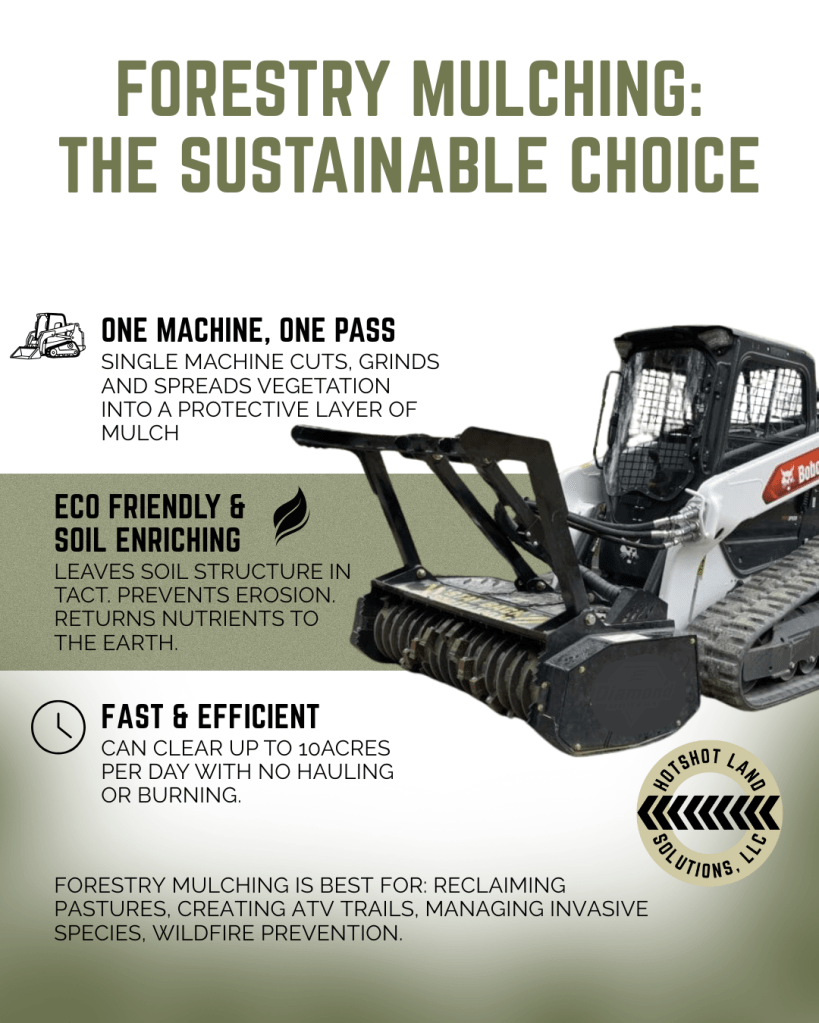
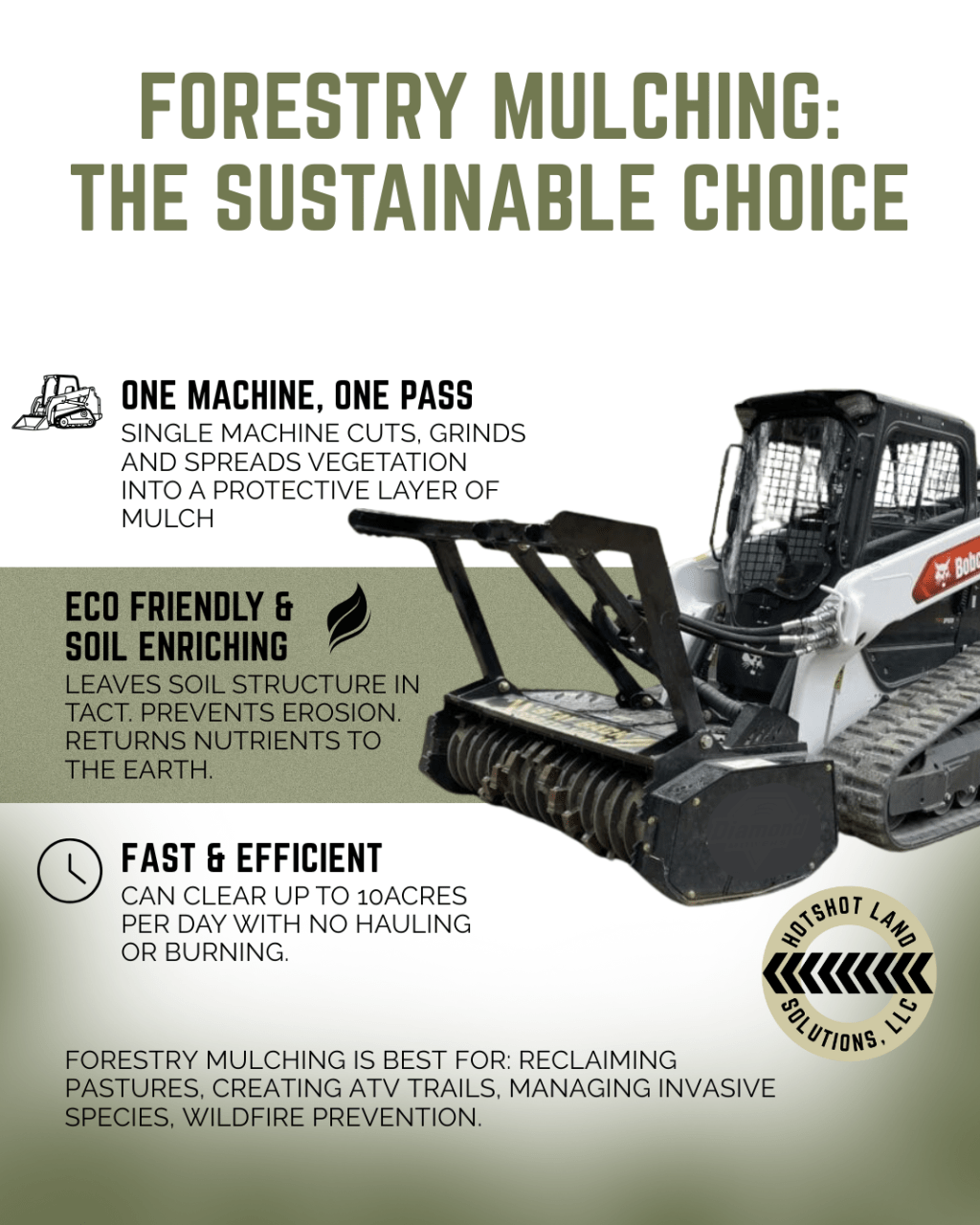
Below are the key advantages of using forestry mulching to restore your pasture and protect the productivity of your land.
1. Superior Soil Health and Erosion Control
Traditional land clearing is often aggressive, involving bulldozers that push over trees and pull out stumps. This process can cause significant soil disturbance and remove vital topsoil along with root systems.
- Minimal Disturbance: Forestry mulching leaves the soil structure and many root systems intact, which helps stabilize the ground and reduces the erosion often seen after traditional clearing.
- Nutrient Recycling: The organic mulch left behind decomposes over time, returning nutrients to the soil and acting as a natural fertilizer for future pasture growth.
- Natural Barrier: The mulch layer regulates soil temperature and moisture while acting as a natural weed suppressant, helping prevent invasive species from immediately reclaiming the cleared area.
2. Cost and Operational Efficiency
One of the most significant benefits of forestry mulching is that it’s a single-step process.
- Single Machine: Traditional clearing often requires multiple pieces of equipment [bulldozers, excavators, haul trucks]. Mulching uses one machine to cut, grind, and clear simultaneously.
- No Hidden Disposal Costs: Brute-force methods can create large debris piles that must be hauled away or burned, adding labor, fuel, and equipment rental costs. Mulching grinds debris on-site, eliminating many of those add-ons.
- Time Savings: Depending on terrain and density, a forestry mulcher can clear up to 10 acres per day. Some self-propelled setups can clear roughly 1 acre per hour, compared to slower tractor-pull configurations.
3. Simplified Regulations and Permitting
Traditional methods that involve burning or major land disturbance often require burn permits or additional environmental considerations.
- Eco-Friendly Compliance: Because mulching does not involve open-air burning or chemicals, it can simplify scheduling by reducing permit-related delays.
- Community Friendly: Mulching avoids smoke and fire hazards associated with burning windrows, which is often unpopular with neighbors and local municipalities.
4. Effective Invasive Species Management
If your pasture is overgrown with invasive species like honeysuckle or multiflora rose, forestry mulching provides an immediate mechanical solution.
- Reseeding Prevention: By grinding plants into mulch on the spot, you reduce reseeding and speed up restoration back to native grasses.
- Selective Clearing: Unlike a bulldozer that clears everything in its path, a mulcher allows selective thinning. You can preserve healthy mature trees while removing unwanted undergrowth, saplings, and invasive growth.
Comparison of Forestry Mulching vs. Traditional Land Clearing
This table highlights the key differences between forestry mulching and traditional land clearing methods, showing how forestry mulching excels in equipment efficiency, soil impact, debris handling, speed, and overall results.
| Attribute | Forestry Mulching | Traditional Land Clearing |
|---|---|---|
| Equipment | Single machine operation | Multiple machines required |
| Soil Impact | Minimal disturbance, preserves soil structure | Significant disturbance, removes topsoil |
| Debris Management | Grinds debris on-site, no disposal needed | Creates large debris piles, requires disposal |
| Speed | Clears up to 15 acres per day | Slower, often less than 1 acre per hour |
| End Result | Healthier land, promotes future growth | Disturbed land, potential for erosion |
In summary, forestry mulching stands out as the more efficient and environmentally friendly option for land clearing. It offers major advantages in equipment use, soil preservation, debris management, operational speed, and the overall health of the land after the work is complete.
If you have an overgrown pasture and the goal is to restore grazing land or hay fields, forestry mulching is often the superior choice because it leaves the land in a healthier, more productive state immediately following the work.
Frequently Asked Questions
What types of land are best suited for forestry mulching?
Overgrown pastures, brushy fence lines, and lightly wooded areas are perfect candidates for forestry mulching.
Forestry mulching works especially well on land with dense brush, saplings, and small trees, including invasive species pressure. It’s a strong fit when you want to reclaim usable ground while preserving topsoil and minimizing disturbance. If you’re not sure, a quick site review can confirm whether mulching is the most efficient route for your terrain and goals.
How does forestry mulching impact local wildlife?
It can support wildlife long-term by improving habitat and encouraging native regrowth.
Mulching leaves organic material behind that feeds the soil and helps native plants rebound, which can improve food and cover for wildlife. Selective clearing also helps preserve mature trees that many species rely on. Timing matters though, so it’s smart to avoid peak nesting windows when possible.
Can forestry mulching be used in residential areas?
Yes, it’s a great option for residential lots because it’s cleaner, contained, and doesn’t require burning.
Mulching is commonly used for overgrown yards, trail cuts, clearing brush lines, and invasive management near homes. Since debris is processed on-site, you avoid big piles and hauling, and you skip the smoke and fire risk that comes with burning. Always check local restrictions, then let a pro help plan the cleanest approach for neighbors and property lines.
What are the long-term benefits of using forestry mulching?
Better soil, less erosion risk, and a faster path back to healthy grass and usable land.
The mulch layer breaks down over time, returning nutrients to the ground and helping stabilize moisture and temperature. Because the process disturbs the soil far less than dozing, you reduce erosion and keep the land more productive. Over time, this supports stronger pasture recovery and fewer “start over” clearing cycles.
Is forestry mulching environmentally friendly?
Yes, it’s one of the more land-friendly clearing options because it avoids burning and protects topsoil.
Mulching keeps organic material on-site instead of sending it to burn piles or haul-off, and it minimizes soil disruption compared to brute-force methods. That helps preserve soil structure and reduces runoff issues. It also helps limit reseeding from many invasive plants by grinding material in place.
How does forestry mulching compare to other land clearing methods in terms of cost?
It’s often more cost-effective because it’s a single-step process with fewer machines and fewer surprise disposal costs.
Traditional clearing can stack costs fast with multiple machines, labor, haul-off, and burn management. Forestry mulching typically combines cutting, grinding, and clearing into one workflow, which can mean faster completion and less overhead. Final pricing still depends on density, terrain, and access, but mulching tends to win when you factor in the full project, not just the first day.
Ready to Reclaim Your Pasture?
If your property is getting choked out by brush, saplings, or invasive Eastern red cedars, don’t wait until it turns into a bigger, more expensive project. Forestry mulching is a fast, efficient way to clear overgrowth while protecting your soil so grass can come back stronger.
Contact Hotshot Land Solutions today for a free estimate. Send us your acreage and a couple photos of the area you want cleared, and we’ll help you map out the best plan to get your land back to usable, open pasture.
 Hotshot Land Solutions | Oklahoma Land Clearing